
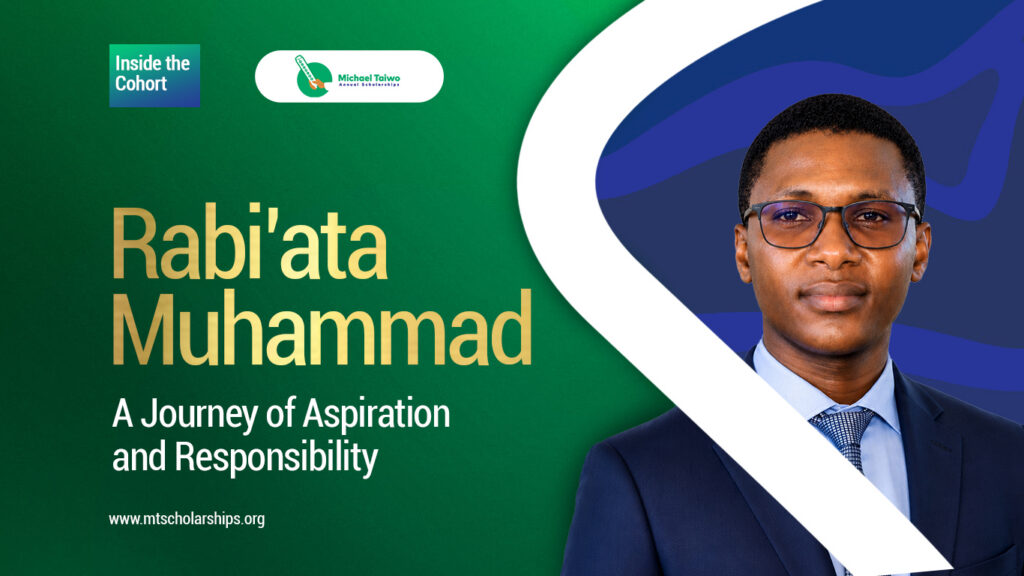
Rabi’ata Muhammad: A Journey of Aspiration and Responsibility
 The Admin
From a childhood shaped by financial hardship to graduating with First Class honours and becoming a 2026 Michael Taiwo Scholar, Rabi’ata Muhammad’s story is one of sacrifice, resilience, and a determination to create opportunities for others.
“I want to see you called Dr.”
Rabi’ata Muhammad’s mother would watch the news at other people’s houses. Whenever someone on the screen was addressed as “Dr.”, she would tell her son, “I want to see that day that you will be called Dr.” She loved the sound of it. Rabi’ata would tease her that she wanted him to spend his entire life studying.
She did not know how much that simple wish would come to mean.
The First of 30 to Attend University
Rabi’ata grew up in Gombe State, northern Nigeria, as the 16th of 30 surviving children. More than 40 children had been born to his father, a vulcanizer with four wives. His mother was a homemaker who washed dishes and did laundry for other people to help pay for her children’s education.
When Rabi’ata started primary school at five, the school waived half his fees because of his family’s financial circumstances. His mother worked to pay the remainder. In secondary school, an uncle helped with his fees while she covered the balance.
His academic ability soon became evident. At JIBWIS Islamic Science School in Bolari, Gombe, he graduated as the best science student and the school’s highest scorer in the Joint Admissions and Matriculation Board (JAMB) examination. He also won the 774 Young Nigerian Scientists Presidential Award for Gombe State.
Eventually, he became the first of his father’s surviving children to attend university. But brilliance alone could not pay university fees.
When ₦5,000 Stood Between Him and University
Rabi’ata once dreamed of becoming a pilot until he discovered the cost of the training. He turned to engineering, drawn by its possibilities. In 2018, however, he applied to study medicine at his state university. At 16, he was invited for physical screening, but the ₦5,000 fee stood between him and the next step. Neither he nor his family could afford it.
He missed the opportunity that year and worked as a tailor while his mother continued working. Together, they saved approximately ₦70,000. In 2019, the money covered his university application, registration at the University and the foodstuff he took to school. He began studying Chemical Engineering at Modibbo Yama University in Yola. Sometimes, the distance between a young person’s potential and its fulfilment is not a lack of ability. It is a fee that cannot be paid or an opportunity that arrives before the money to pursue it.
When the Weight of Responsibility Became Personal
University offered Rabi’ata a path forward, but it did not remove the realities of the home he had left behind. In 2023, while he was in his third year, his younger sister revealed that their mother had stepped on an ember while doing domestic work at someone else’s house. Because she had diabetes, the burn had developed into a severe ulcer on her foot. Rabi’ata was in Yola. His mother was in Gombe.
When he asked why she had not told him, she replied, “Rabbi, don’t worry. Hey, I am fine. I didn’t want to bother you. I need you to focus on your studies.”
But he could not simply focus on his studies. He emptied the account where he had been saving his scholarship money for postgraduate preparation, including the GRE, IELTS and an international passport. He sent the money home to help pay for his mother’s treatment and food.
She spent nine months at the Federal Teaching Hospital in Gombe and recovered. Months later, an ulcer developed on her other leg. Around July 2024, she died from diabetic complications.
Rabi’ata had already lost his eldest sister during childbirth in his first year at university and an uncle in a road accident the following year. Three months after his mother’s death, his aunt, who was his mother’s youngest sister, also died.
He was 22, still an undergraduate, and had assumed full financial responsibility for his two younger siblings, both of whom he continues to support through university.
Three Weeks on the Road, Two Months Behind in Class
Even as he dealt with personal loss, Rabi’ata had to find ways to keep himself in school.
In his 400 level, he began accompanying his brother-in-law on long-distance truck trips from northern Nigeria to Port Harcourt. Each trip lasted about three weeks and paid ₦20,000, which went towards food and other expenses. The work came at a cost: during some semesters, he returned to campus as much as two months after lectures had begun.
By his final semester, the scholarship funds he won for his studies had dried up. Chevron had not paid him for two consecutive years, while his TotalEnergies and Federal Government scholarship payments had ended. His next MTN Foundation payment was not yet due.
Then he broke a laboratory condenser that cost ₦9,000 to replace. With no money to pay for it, he took daily shifts at a block-making industry until he had earned enough to replace the equipment and return to his research.
His final-year project focused on producing biodiesel from waste animal fat using a catalyst made from eggshells.
Between COVID-19 lockdowns, university strikes and financial hardship, his five-year degree stretched across six calendar years. He graduated with First Class honours in Chemical Engineering, emerging as the best student in his department, the Faculty of Engineering and the entire university.
What Scholarships Gave Him, He Gave Back
Rabi’ata had won four scholarships as an undergraduate: TotalEnergies in 2021, the Chevron/Agbami Medical and Engineering Professionals Scholarship in 2022, and the Federal Government and MTN Foundation scholarships in 2023. He also received more than ten academic awards.
He learnt about many of these opportunities through lecturers who had studied abroad and accounts on X that shared scholarship information. He did not keep that knowledge to himself.
While still an undergraduate, he mentored ten students from financially disadvantaged backgrounds. Four graduated with First Class honours and six with Second Class Upper honours. Six of the ten subsequently won competitive scholarships after he coached them through aptitude tests.
One of his mentees, a Mechanical Engineering student, graduated with First Class honours and secured scholarships from Shell, PTDF, FSBN and the MTN Foundation, together worth more than ₦1 million.
Rabi’ata also tutored younger students in Physics and Mathematics. When some of his mentees did not win scholarships, he gave them part of his own scholarship money. He encouraged those who succeeded to pass similar opportunities on to others.
His understanding of success extends beyond personal distinction.
“Success is not my achievement alone, but also the number of lives I have had an impact on, the number of lives I have changed, and the number of people that achieved success through me.”
Having experienced how financial constraints could stand between talent and opportunity, he became determined to ensure that other students would not have to navigate the same challenges alone.
The Next Chapter: A Dream His Mother Hoped to Witness
Rabi’ata’s journey eventually brought him to the attention of the Michael Taiwo Scholarships. Dr. Michael Taiwo personally conducted his scholarship interview. According to Kole Ochayi, the Executive Assistant, who later spoke with Rabi’ata during a video interview, Dr. Taiwo was so moved by his story that he told the team, “Now we just have to share this story.”
Rabi’ata was selected as one of the 69 Michael Taiwo Scholars for 2026, from 9,198 applicants.
His next ambition is to pursue a fully funded PhD in Systems Engineering for Sustainable Energy at a leading international university. His research interests include process systems engineering, artificial intelligence for process optimisation, and carbon capture and storage. He hopes to use this expertise to develop cleaner, more efficient energy systems for Africa.
After being asked what he wished someone had told him when he was younger, he said he could become influential, rise above his circumstances and make history wherever he found himself.
To others facing similar challenges, his message is simple:
“Talent is universal. Talent is everywhere, but opportunity is not.”
His story is a reminder of what determination can achieve, but also of how much talent risks being lost when opportunity is out of reach. It is a story about the sacrifices families make, the importance of access to education, and the responsibility to create opportunities for others when we find them ourselves. There is, however, one dream that remains deeply personal.
His mother wanted to live to see the day he would be called “Dr.” She did not live to see him graduate with First Class honours or become a Michael Taiwo Scholar.
The PhD is still ahead of him.
So is the day he hopes to be called “Dr.”
And although his mother will not be there to witness it, the dream she carried for him continues to shape the future he is working towards.
Contributors

Gloria Austin
As a writer for the MT Scholarships blog, Gloria turns ideas into impactful stories, helping to build a vibrant and informed community for all scholars.
Naomi Okikiri
Naomi Okikiri is a writer, passionate about Accounting, Finance and Development
Be Part of a Global Dreaming Tribe
Connect. Grow. Inspire — Join Dream Lounge. Your monthly dose of stories, strategies, and scholarship support to help you rise.